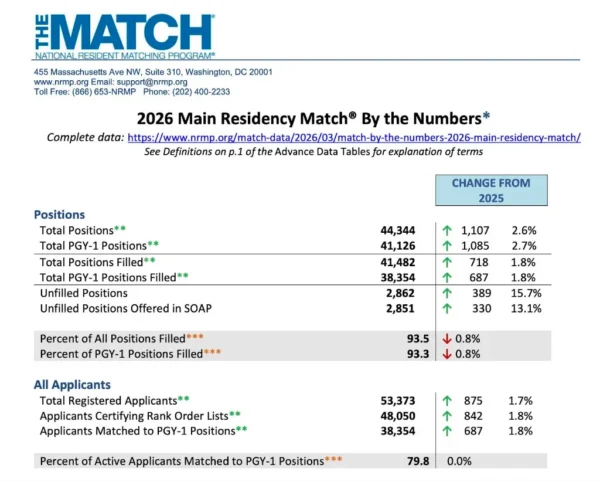
We’re talking frankly about a strange medical recruiting system: One in which there are clearly vacancies, and there are also a lot of people desperate for them. But in the end, the two sides passed each other and could not meet each other at the destination.
To make it easier to visualize, imagine a simple mathematical scenario. You have 100 chairs in a room, and 120 people are standing outside the door wanting to sit in. In a normal mechanically operating system:
- The 100 best people will be seated.
- The remaining 20 people will accept to leave because there is no more space.
👉 Absolutely never have a chair in the room still empty… but people outside still have to stand and suffer.
However, American boarding student (The Match) is a system that operates according to such a paradox: There are both an excess of empty seats and an excess of people without a place.
The core reason why this happens is because: The Match system absolutely does not operate according to the mindset of “whoever has the better score is chosen by default”. If Match were truly a pure scoring exam – where whoever scores higher wins, whoever prepares better gets a spot – then the result is extremely simple: all residency positions across the United States would be filled to the floor before a candidate was eliminated.
But the reality on the ground does not happen like that. And this is the clearest warning sign: You are not participating in an academic exam, but rather you are participating in a strategic choice system.
1. The nature of American Boarding: The “choosing each other” route is like a date
To understand in the most basic and easy way, the Match system is completely different from the university exam in Vietnam. It has an algorithm that operates exactly like the process of “finding out and choosing each other” in a date.
You can absolutely be a candidate with an extremely good profile: Good academic performance, high Step scores, beautiful resume and no obvious red flags. But all of those requirements are absolutely no guarantee that you will definitely be selected by a boarding program.
Because a successful “Match” command really appears if and only if two parallel conditions are met:
👉 You choose to rank them high.
👉 And they also choose to rank you high.
If either side is out of phase and refuses to choose the other, the coordination result will be zero.
In this race, a residency training program in the US will never automatically send you a job offer just because you are “good enough” on paper. They only really put you on their selection list when they feel your fit with their culture, and they have enough confidence that you will also seriously choose them later.
At this point, many international doctors (IMGs) began to vaguely realize: “Maybe it’s not because my ability is not good enough”, or “Maybe it’s because I haven’t built a strong enough Network in the US”. But most of you often just stop at that level of thinking. And that’s exactly why they continue to invest time and resources in the wrong preparation directions.
The vital question you need to put on the scale right now is not: “Am I good or not?”. The right question is: “In the eyes of the hiring committee in the US, am I really a reasonable, safe and trustworthy choice?”
2. Hiring Council Mindset: They look for peace of mind instead of intelligence
There is an extremely important implicit truth in American hospitals that very few people tell you directly: The recruitment committee never tries to find the best people. They only focus on choosing the person who makes them feel most secure.
When the board of directors of a residency program sits down to review your US residency profile, they are not trying to hunt for a genius with outstanding intelligence. They are silently putting you on the scale to dissect you through the following 4 practical questions:
- Does this person have a cooperative personality, easy to work with in a large group of people?
- Do they really have a deep understanding of how the US healthcare system actually operates?
- Do they possess similarities to the generations of doctors we have successfully trained in the past?
- And if we decide to push the button to accept this candidate, how much systemic risk do we incur?
To put it bluntly: They are using a medical lens to evaluate the level of “safety” (risk assessment) when choosing you, not simply grading your abilities.
A candidate may possess extremely high USMLE scores and extremely scholarly background knowledge; But if the profile is completely empty about clinical field experience in the US (USCE), lacks letters of recommendation (LORs) from trusted US doctors, and does not show cultural harmony in behavior during the interview… then that person is still labeled as a “high risk” case.
And you need to remember, in a high-pressure working environment like a residency training program, risk aversion is always the top priority of Program Directors.
3. Overqualified paradox: When you are eliminated, it is not because of your lack of ability
When faced with this harsh reality, many IMG students often feel timid and self-conscious like: “Well, I’m a foreign doctor, if there’s any place in the US that offers alms to work, I don’t have the right to ask for a choice.”
At first glance, it seems very reasonable and I know you know me. But from a strategic perspective, this is a fatal mistake.
You need to change your thinking: You are not someone who “applies for a job” from a position of weakness. In the Match system, you are an independent entity participating in a fair platform, where both parties (candidate and employer) are having equal rights to evaluate and evaluate each other.
On the other side of the battle line, recruitment programs in the US also always have a fear: “Does this candidate really want to contribute to my center, or are they just pretending?”.
If through your profile and interactions, they feel you:
- Just considering their program as a temporary “backup plan” for anti-slip application.
- Or you cannot give a clear, convincing reason why you chose their city and hospital.
Then immediately in their eyes, you turn into an “uncertain” choice. And for Americans, uncertainty means exclusionary risk.
This is the birthplace of a medical paradox that many people cannot see: If you possess outstanding ability but apply to a program with a ranking much lower than your stature, that program can completely disqualify you.
The reason is because the admissions committee will think: “This candidate is too excellent, they probably just applied for fun and never bothered to rank their program high. Interviewing them is just a waste of time and hospital quotas.”
The paradox here is: You are rejected and eliminated completely not because you are incompetent, but simply because they know for sure you will not choose them in the end.
4. Actual data from Match 2026: A game of strategists
To prove that The Match is a strategic positioning problem, not a score game, let’s look directly at the fierce actual statistics table recorded from the recent The Match 2026 period. via:
| Match 2026 statistical index | Actual quantity |
|---|---|
| Number of vacant boarding positions (no Matches) | 2,862 positions |
| Number of candidates (including AMGs & IMGs) not matched | Nearly 9,700 candidates |
Looking at this data table, we see a harsh truth: Nearly 3,000 doctor’s chairs still lie empty, while nearly 10,000 people out there still have to stand and suffer because of failure.
This phenomenon is absolutely not a random coincidence. It is strong evidence to confirm:Match is never a race for those who work hard to earn points. It is a brain game of strategists.
The strategy here is not at all about blindly trying to force yourself to do more work. Proper strategic thinking must include the following 5 core pillars:
- Accurate positioning: Clearly understand the actual capabilities and position of your profile in which segment.
- Choose the right track: Wisely choose a specialty and stratify program levels appropriate to the weight of your application.
- Risk management: Focus on designing the application in the direction of completely eliminating doubtful points and minimizing risks for the employer.
- Story consistency: Build a personal story (Personal Statement & Interview) that is coherent, consistent and easy to understand.
- Target the right target: Proactively appear and approach directly to programs that have compatible recruitment characteristics and are most likely to select you.
When you choose to commit without a sharp strategic mindset, you can plow through a lot of work, sweat a lot… but the end result is still being stuck in one place.
Conclusion
The biggest and most regrettable mistake of IMG doctors is the spirit of “eagerness to run in the wrong direction”. When you optimize in the wrong direction, you can invest thousands of hours, sacrifice your health, money and sleepless nights, but all of those efforts are completely deviant from the actual evaluation criteria of admission boards in the US.
Always remember, the ultimate winner in the American boarding school admission is not the best, but always the one who: Deeply understands how the system operates, knows how to accurately determine their own value, and has the ability to prove to the program: “I am the most perfect piece for you, and I will definitely choose you.”
Therefore, the most challenging part on the journey to conquering an American medical residency is not that you have to try to do more work. It lies in:
- You must know clearly what you should do.
- And the most important thing is that you must be alert and know clearly what you should not do.
That is the boundary that shapes the difference. And that is also the reason why despite spending the same level of effort and sweat, there are those who successfully reach the glory of Match, while there are those who forever have to sadly stop outside the door.
What do you think about the behind-the-scenes truths and paradoxes of the American medical Match system? How is your roadmap for preparing your strategic profile currently positioned? Please leave a comment below the article to discuss with me.
If you feel this article provides practical and useful information for your medical journey, please share it widely with your friends and colleagues!
Dr. Christina Nguyen
Phoenix Medical Academy