One of the questions I receive the most from medical students and doctors from Vietnam is: “Which specialty should I choose to have the highest chance of Matching?”
In fact, on this journey there is absolutely no “easy” specialty. But the real truth is that there are specialties that always expand their recruitment targets for more IMGs than other specialties.
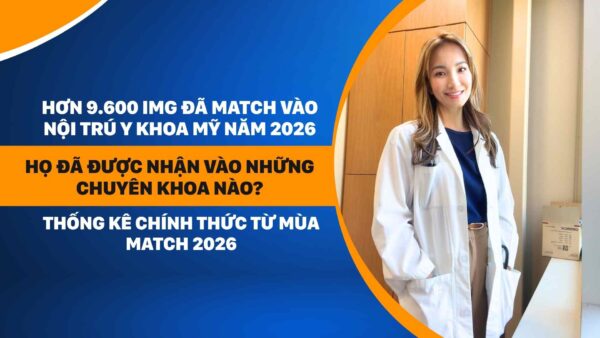
According to the official statistical report just published from the organization NRMP Main Residency Match 2026, this is a list of specialties that recorded the highest number of successful IMGs Matching into first-year resident physician positions (PGY-1) during the past selection season.
To make it easier for you to follow, the US report will clearly classify international candidates into 2 groups:
- Non-US IMG: Doctor graduated from medical school outside the US, does not have a green card or US citizenship (visa sponsorship required).
- US IMG: Doctors who graduated from medical schools outside the US, but already possess a green card or US citizenship.
1. Top 6 American medical specialties recruiting the most IMGs in Match 2026 season
1. Internal Medicine
This specialty continues to hold the top position in terms of the highest number of IMG Match candidates in the system:
- 3,448 non-US IMG group candidates.
- 1,060 US IMG group candidates.
- Total: Up to 4,508 IMGs were admitted to this specialty.
Internal medicine has long been the top choice because it is a solid foundation for doctors to continue to specialize in future fellowship programs, such as Cardiology, Gastroenterology, Respiratory – Intensive Care, Hematology – Oncology and Nephrology.
2. Family Medicine
Family medicine continues to affirm its position as one of the pillars recruiting the most IMGs in the US:
- 962 non-US IMG group candidates.
- 585 US IMG group candidates.
- Total: There were 1,547 successful IMG Matches.
This is an extremely suitable choice for those who love the field of primary health care, want comprehensive treatment and want to build long-term medical relationships with patients as well as the indigenous community.
3. Pediatrics
The Pediatrics department still maintains its attraction and demand for human resources is very stable:
- 684 non-US IMG group candidates.
- 213 US IMG group candidates.
- Total: Recorded 897 IMGs entering the system.
Every year, pediatrics is always in the group of specialties with a large proportion of international doctors contributing to the US hospital system.
4. Specialization in Emergency Medicine
After a period of great fluctuations in previous years, the Emergency Department has shown stability:
- 93 non-US IMG group candidates.
- 319 US IMG group candidates.
- Total: There were 412 successful IMG Matches.
Notably, job opportunities in this specialty show a clear strength in the group of international doctors who already have working papers in the US (US IMG).
5. Psychiatry
The need for mental health care in American society has continuously grown strongly in recent years:
- 222 non-US IMG group candidates.
- 177 US IMG group candidates.
- Total: Successfully reached the milestone of 399 IMG Matches.
This trend has turned Psychiatry into a specialty that receives great interest and applications from the international candidate community.
6. Pathology
Although the total number of vacancies across the United States in this field is not as huge as Internal Medicine or Family Medicine:
- 170 non-US IMG group candidates.
- 50 US IMG group candidates.
- Total: 220 IMGs were admitted.
However, Pathology has long been a traditionally friendly destination for IMGs. This major is especially suitable for those who are deeply academically oriented, passionate about scientific research, or have a personality that does not like clinical environments that require direct daily contact with patients.
2. Historical record numbers for the 2026 Match season
In addition to the list of specialties, the NRMP report also announced notable macro indicators of the Match 2026 season:
- Milestone: The system opens 44,344 first-year resident physician positions – this is the largest number of vacancies in NRMP’s history.
- Total number of successful IMGs: Recorded 9,682 successful IMG Matches into the US healthcare system, including: 6,733 candidates in the non-US IMG group and 2,949 candidates in the US IMG group.
- Actual Match Rate by Group: The US IMG group achieved a success rate of 70.0%. Meanwhile, the non-US IMG group achieved a stable rate at 56.4%.
3. Look straight at the truth: Is choosing a specialty with many criteria the easiest to match?
This is the part where I want you to stop for a moment and think carefully. Many people, when looking at this table of statistics, will immediately come to a quick conclusion: “Then I should just choose to apply to Internal Medicine which is the easiest to match because their quota is the largest.”
Actually, this is a superficial and incomplete understanding of the strategy:
- Internal medicine has the largest number of IMG Matches, but in return, this is also the specialty that receives the largest number of applications (candidate pool) and has the fiercest competition.
- Family medicine offers many open opportunities, but not every candidate’s resume style or personality fits the industry’s recruitment criteria.
- Pathology recruits quite a few IMGs, but if your entire profile does not show a real interest and passion for this specialty, it will be very difficult for you to compete with other competitors.
- Psychiatry is receiving more and more attention, which means the level of application testing is much more rigorous than before.
Therefore, the core problem you need to solve is not: “Which specialty has the most IMG Matches?”. The correct question must be: “With my current profile structure, which specialty will be the smartest and most optimal strategic choice?”
4. Strategic advice from Dr. Christina Nguyen
What I feel most happy and proud of when looking at the statistics of this year’s Match season is that international doctors are still continuing to Match, and the number of successes is huge.
The path to conquering the American medical residency program has never been an easy journey. But the above numerical evidence shows that life-changing opportunities still exist in a fair way for those who have serious preparation, clearly understand their own strengths and weaknesses and know how to build the right profile strategy right from the starting line.
To determine your own journey map, start by sitting down and answering these 3 guiding questions:
- With my current capacity and profile structure, in which specialty will I be suitable and create the greatest impact?
- What pieces are missing from my profile to become a highly competitive candidate (Scores, USCE, or letters of recommendation LORs)?
- What specific actions do I need to start preparing now to get ahead of the next Match season?
If you are a medical student about to graduate or a young doctor in Vietnam who is carrying the dream of conquering the American dream, but are still vague and need in-depth guidance and roadmap orientation, please proactively message your inbox directly for advice. and support.
What do you think about the statistics and industry trends of this year’s Match season? Please leave a comment below to share your perspective with me. Don’t forget to share the article widely if you feel it brings useful value to the surrounding medical community!
Dr. Christina Nguyen
Phoenix Medical Academy