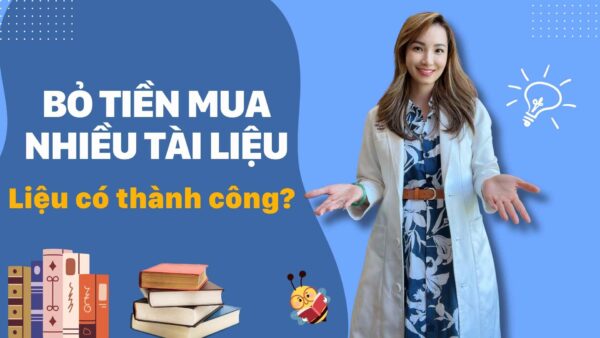
This may be controversial, but…
…spending money to buy a lot of expensive study materials will not help you pass the exam USMLE step 1.
Let me tell you my USMLE study story.
Previously when I was studying for the USMLE exam, I spent money to buy a lot of Question Banks – Kaplan, Uworld, Amboss, and all the study programs – Pathoma, Kaplan, Picmonic, Sketchy, and study tools – Anki, Quizlet. But I still always feel insecure. Insecure because I feel like the amount of knowledge is too huge – I can’t finish studying, I forget what I learned later, I spend a lot of time studying, but I still type the questions wrong and the test results are still low. I’m always worried that my time is running out and I haven’t finished studying yet. What if I fail the exam? I feel like I’m distracted because of these thoughts of mine.
And the more I worry, the more hopeless I feel. So when I see a new book or a new set of questions, I immediately buy it to study, hoping that it will be my salvation.
But then, the more I study, the more I realize that “having a lot of materials” to learn is not necessarily a good thing. Actually, each set of documents is designed according to a different roadmap, with a different way of arranging knowledge, and largely depends on the author’s way of thinking and brain – how they approach the problem.
And in reality, no set of documents or curriculum is perfect. Every set has its own strengths and weaknesses. Some of my friends in my class consider the book First Aid as a bible, but others find First Aid too summary.
Not only that, using too many materials to study also makes you waste time and effort in vain. Believe it or not, I once bought and read the book “Robbins Basic Pathology” because I heard from my seniors that this book was very useful. This book has nearly 1000 pages and weighs more than 5kg! Luckily, I quickly gave up this silly job.
Since then, I have understood that the USMLE step 1 exam results do not depend on what study materials you have, but it depends on how you use these materials.
When I understood this, I woke up and felt much more confident. I have a different learning strategy, where I have the initiative in learning and the system of knowledge I need to grasp, instead of trying to dive into a mess of knowledge.
With this learning strategy, I was successful and became a doctor in the US today. Not only that, I also help students in my “1:1 Coaching – Become a Doctor in America” program pass USMLE step 1 on the first try.
If you are serious about becoming a doctor in the US and want a strategy that will lead you to success, send a message to your inbox for advice!
Wishing you a peaceful and healthy day.
Dr. Christina Nguyen
Phoenix Medical Academy