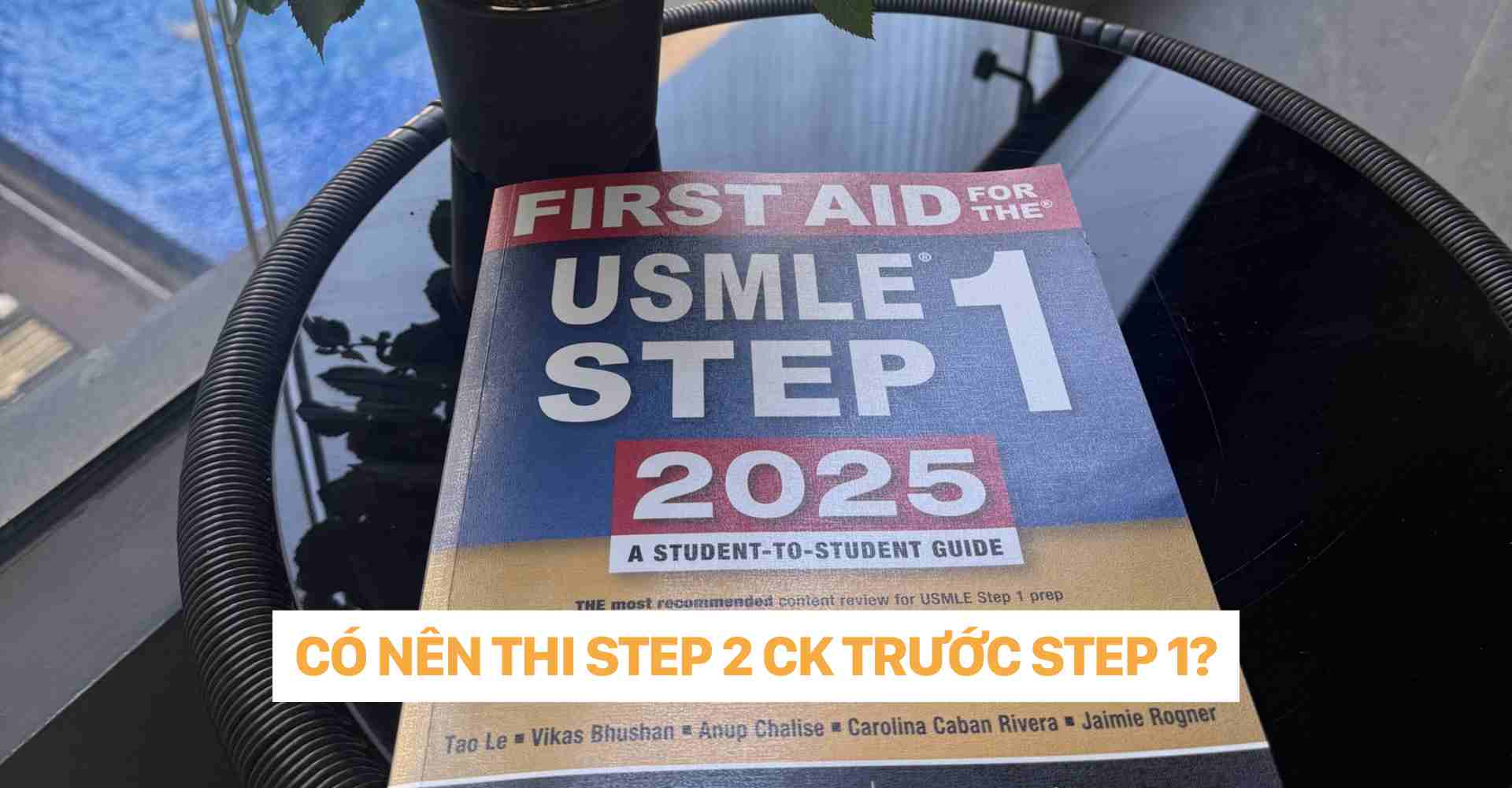
SHOULD I TAKE STEP 2 CK BEFORE STEP 1?
As someone who has discussed with many IMG (International Medical Graduates) about the USMLE journey, I often receive the question: “Should I take Step 2 CK before Step 1?”
Recently, a friend texted me asking this, and when I asked why, he shared that Step 2 CK feels “closer” because it involves a lot of practical clinical knowledge, and learning Step 2 CK is “better and easier to do” than Step 1.
I understand that feeling – who doesn’t like to learn practical, immediately applicable things, instead of having to re-learn the dry basic science of Step 1? But after thinking and based on experience, I still advise her – and other IMG students – to take Step 1 first.
Choosing to take Step 2 CK before Step 1 may be attractive because of the initial “easy” feeling, but hidden behind it are big strategic and psychological risks that IMGs need to consider carefully. Strategically, USMLE test order is not only a personal matter but also affects how residency programs evaluate your application.
Step 1 has now switched to a pass/fail format (from 2022), meaning you only need to pass the threshold to complete, while Step 2 CK still requires a specific – and often very high – score to compete for residency.
If you take Step 2 CK first and don’t get an excellent score, the pressure will back up when you return to Step 1. At this point, you not only need to pass but also have to maintain your spirit to continue to improve your Step 2 CK score afterward. On the contrary, if you take Step 1 first, you complete a basic milestone (pass/fail is simpler), then put all your effort into Step 2 CK to get a high score – which is really important in the eyes of residency programs.
Furthermore, learning Step 1 first is not only a matter of order but also helps you develop an effective mindset and learning style for Step 2 CK. Step 1 with 280 questions in 8 hours forces you to practice integrated thinking ability, linking knowledge from many subjects such as physiology, anatomy, and biochemistry to solve problems.
This process will create for you a deep, systematic learning habit – from understanding the nature, remembering for a long time, to applying flexibly – extremely necessary skills when studying Step 2 CK. Once you get used to the “heavy” learning style of Step 1, you will find that accessing clinical knowledge in Step 2 CK becomes easier and more effective.
This is especially important because Step 2 CK requires high scores to stand out; A good thinking foundation from Step 1 will help you handle complex clinical questions better, thereby increasing your chances of achieving an impressive score.
Psychologically, delaying Step 1 to jump to Step 2 CK can erode your confidence and motivation over time. Step 1 is a big challenge, and when you avoid it first, you unintentionally tell yourself that you’re not ready, creating a psychological “knot” that lasts. By the time you face Step 1 after Step 2 CK, you may be exhausted or lose focus to review basic science from the beginning.
On the contrary, if you pass Step 1 first – even if you just pass – you will have a feeling of victory, entering Step 2 CK with a more comfortable and confident mind to conquer high scores. In addition, once you get used to the pressure and learning style of Step 1, you will be less overwhelmed by the difficulty of Step 2 CK, helping you optimize your performance and achieve better results.
Another psychological risk is comparison and external pressure. In the IMG community, many people still follow the Step 1 route first, then Step 2 CK. If you choose the opposite and encounter difficulties – like a low Step 2 CK score or delaying Step 1 for too long – you may doubt yourself when you see your friends have progressed further.
On the contrary, taking Step 1 first, passing it, then focusing on getting a high score in Step 2 CK will help you synchronize with the general roadmap and reduce unnecessary pressure. In short, learning Step 1 first not only reduces risk but is also a smart way to train your mind, build a foundation, and optimize your Step 2 CK score – the deciding factor in the residency race.
I understand the feeling of wanting to “take the short route” by choosing Step 2 CK first, especially when you are familiar with the clinical environment and find Step 1 strange and dry. But look further: Step 1 is not just an exam, but an important preparation step for you to shine in Step 2 CK, Step 3, and the entire residency journey later.
I recommend starting with Step 1 – invest your time, build an effective learning method, and get over it. Once you pass Step 1, you will find that Step 2 CK is not only easier to “enter” but also much more interesting, because you have a solid foundation to rely on. Don’t rush, go in the right order – success will come if you are patient!
What do you think about taking Step 2 CK before Step 1? If you have any comments or questions, please leave a comment, I’d love to hear more from you!
Dr. Christina Nguyen
Phoenix Medical Academy